

Fun listen: I was on the Libby podcast Book Lounge with Clare Mackintosh and Lisa Gardner and I learned so much from these thriller queens.
Great list: Parisian Heist is one of the NY Post’s top beach reads this summer. This is a great list all around.
Hello, hello from the beautiful island of Lošinj where I’m wrapping up the Adriatic Writer’s Conference.
It’s been an incredible week here filled with craft talk, delicious dinners, so much good writing time, love, laughter and new friends.


Since I’ve been teaching craft, technique, writing and research this week, I’ve developed a lot of thoughts on the recent Belle Burden controversy over Strangers.
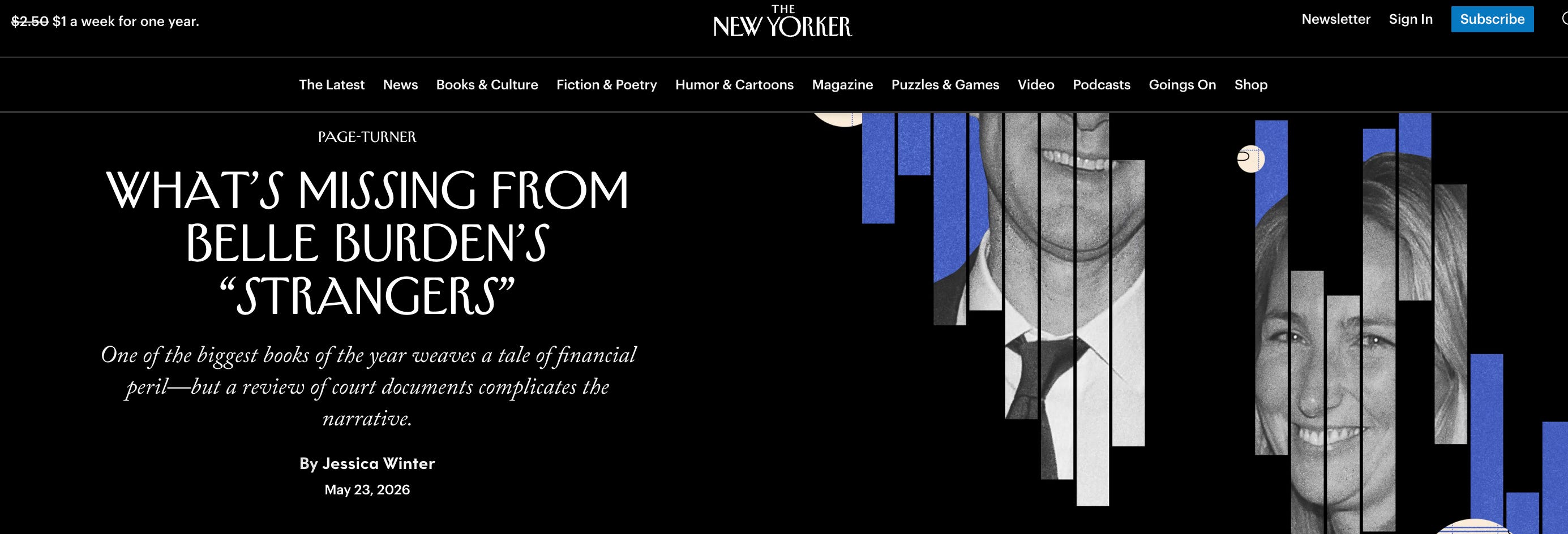
For anyone who missed the drama, a recent New Yorker piece revealed details about Burden’s family wealth and financial circumstances that weren’t fully disclosed in the memoir. Suddenly readers who had spent hundreds of pages worrying that she might lose everything were asking whether she was ever really at risk.
One side is shouting that she lied and that negates the whole book. The other says it doesn’t matter even if she did, that wealth doesn’t protect you from betrayal, abandonment, heartbreak, or emotional abuse so it doesn’t matter what she said or didn’t say in the book.
I don’t think she lied. It’s a bit more complicated than that.
I do think that all of us are unreliable narrators of our own story and that we self-select what to tell and how to tell it. I also think Burden probably got significant editorial direction from various places to make sure she was both relatable and that the book had stakes that kept moving the reader forward. We’ve been talking a lot about stakes this week in our writing workshops. Why do you keep turning the page? A lot of readers told me it was because despite her wealth they worried she would lose her home.
This makes sense.
How can you relate to a multi-million with an insane amount of generational wealth (a trust in excess of $63 million), two gorgeous houses, kids in private schools and a trust fund? Take away the place where she and her children feel safe and protected, her home (homes), something many women can relate to even if they don’t have eight-figure properties.
Those questions made us anxious on her behalf and they also made us empathize with her.
Now we’re learning that even if the worst-case scenario had happened, Burden possessed a level of generational wealth and financial security that most people will never experience. Losing those homes would have been devastating. It would have been painful. It would have been humiliating.
But would it have left her financially insecure?
Probably not.
She also didn’t end up losing them.
She probably could have lost the houses depending on how the divorce proceedings went down. It probably was a real, if slight, possibility. But if she lost them she still would have been fine.
What you choose to leave out inevitably shapes the story you’re telling sometimes even more than what you leave in.
If a reader believes a woman is standing on the knife’s edge of financial ruin, they experience the story one way. If they know that same woman has a substantial family safety net, they experience it another way.
They’re different stories. I liked this book a lot. I hand sell it at our bookstore. I think Burden is a beautiful writer.
I also like the book despite the fact that I didn’t relate to Burden at all.
Her life has been so filled with wealth and privilege that it might as well be set on another planet and the tiny sliver of humans with this much money are living completely different lives from you and I.
I also couldn’t relate because she was so ridiculously naive and dare I say, stupid, about her finances in a way that only someone who has grown up crazy wealthy can be.
I was stunned by how completely she handed over control of her agency and her finances.
And yet I couldn’t stop reading. The cautionary tale still resonates and it is an important one. Women must be vigilant about protecting ourselves, our families and our finances. This message matters and I am glad that it is entering our cultural conversation because of this book.
My own mother handed over our finances to my father. It was easier not to deal with it, she used to say. When he died she found out that he’d spent all of the small inheritance she got from her own mother and taken out a second mortgage on their house without telling her. She had nothing. Thankfully mom was a teacher with a pension and good health insurance for the rest of her life. But we had to do a lot of financial acrobatics to figure out what her life would look like when he died.
Finances are too often seen as the purview of the MAN. That’s bullshit. Let’s keep talking more about that. I did a great podcast episode awhile back with Amanda Holden about How to be a Rich Old Lady that really dissects all of this.

What Burden did in Strangers is so indicative of the lives of influencers we consume on a daily basis. They choose what to tell and show us. They craft their story arc so that it bends slightly in the same shape as their own life, but is largely influenced by what will maintain your attention and get you to buy the things they’re selling.
It’s complicated, like most things. I also think it sparks an interesting conversation about what a memoirist owes their readers and how much creating a market for a book shapes a narrative. Would love to hear your thoughts in comments.
As promised last week here is a sneak peek into the orders for Parisian Heist. I was so scared (and a little ashamed) to do this, but I have been hanging out with my friend and fellow author Andi Bartz this week and she is so encouraging about finding new ways to make the publishing industry more transparent so that other authors know how to advocate for themselves. I love her for this.
So this is just a quick and dirty first glance. It’s not great and it scares me a little. So far I am at 744 total preorders for Parisian in print and e books. 300 of those are hardcovers. They don’t measure early audio, nor does it count for bestseller lists. Last week the books at the bottom of the New York Times hardcover fiction bestseller list allegedly sold 7,463 and 8,530 hardcovers. The top seller was the new Matt Dinniman book with 94k hardcovers sold (a triumph!).
So we are about 7,000 sales away from hitting the bottom of the NYT bestseller list. It’s frustrating math because there is very little I can actually do beyond what I already do. And while I think bestseller lists are flawed and shouldn’t matter as much as they do, they are a huge factor in whether a book gets a shelf life in bookstores and with press longer than about two weeks.
Is this a gentle nudge to encourage you to order, to tell your friends to order Parisian and to help me spread the word about this delicious book. Of course it is. But I also hope it helps the writers in my audience gain more insight into the business.
If you have questions leave them in comments! And I also know how expensive everything is right now so I am eternally grateful if you choose to spend your hard-earned money here.
I am giving away a one-year subscription to this substack FREE when you pre-order Parisian Heist from anywhere. You can enter your details here and I will add you for free for the next year. I won’t do anything weird with your emails. Except send you glorious musings in the middle of the night.
Great topic. I put the book down when the caretaker drove the Jeep to the private jet airfield, but finished it when it blew up. I'm flummoxed that so many women responded to it. Maybe I've known enough truly rich people to intuit she was in no real danger. And I found her, the husband and the writing pretty dull.
That said, the book came at a time when the stay-at-home wife life fantasies needed a wakeup call. I hope young women read it.
The expose came at a time when the upper middle class needs to realize the true scale of wealth inequality and the massive chasm between them and the truly rich destroying this country. GenZ gets it. GenX and Millennials need to as well.
FWIW - I doubt many women who grew up with single moms blindly hand over their financial security to men. I've been a relationship for 25 years and maintained my own accounts since day one. We must take care of ourselves. NOTHING is guaranteed.
Yes, Burden told her story, her way. That's how writers do it.
And that New Yorker piece was a hit piece planted by her ex husband. It was a low one for that mag IMHO.
The thing that strikes me, and you said it, it that she went all-in financially. And her husband entered into the marriage hedging his bets. She wanted to believe in true love forever (whatever that means) and he was looking out for himself.
In the complicated balancing act relationships become (aka business relationships, as you pointed out to me once), you look for jobs to off load. I do it. You do it. We all do. And for moms balancing every little last emotional task, handing off the glamor of bill-paying just feels easy. That is our fatal flaw.
I hope we're all learning from this book. Listen to the lawyer. Pay attention to the income. Share the big expenses. And squirrel away your own "just in case" $$. Now whose hedging bets?